Building the data foundation for fund operations
Key Findings



Summary
Private capital firms sit on decades of institutional knowledge — deal memos, IC decks, CIMs, consultant reports, portfolio financials, and expert calls — locked inside PDFs, slides, and spreadsheets scattered across file systems with no consistent structure. The standard response is to point a RAG system at the archive and hope. This paper argues for the inverse: use AI to extract structured data from those documents upfront, resolve entities across sources, and build clean relational databases that power AI workflows. It walks through the full extraction pipeline — deduplication, classification, parsing, entity extraction, and entity resolution — explains why structured queries consistently outperform similarity search, and covers how to keep that data fresh once the historical backfill is done.
What you'll learn
A typical private equity or private credit firm holds 5–20 terabytes of accumulated documents. The problem is not that the intelligence is missing. It is that no one can find it, trust it, or use it systematically — and 50–70% of the archive is duplicate or superseded files before anyone reads a page.
RAG fails on this data for structural reasons. Opaque indexing floods retrieval with redundant chunks. Context windows cannot hold a firm's knowledge base. And LLMs scanning fragments cannot traverse relationships, aggregate financials reliably, or keep entity references consistent — "GS" and "Goldman Sachs Group Inc." become separate companies. They also cannot separate depth from volume: a thousand received CIMs in a sector is deal flow, not expertise, while ten internal IC decks with proprietary models are. That distinction is invisible to similarity search and fundamental to any scoring system.
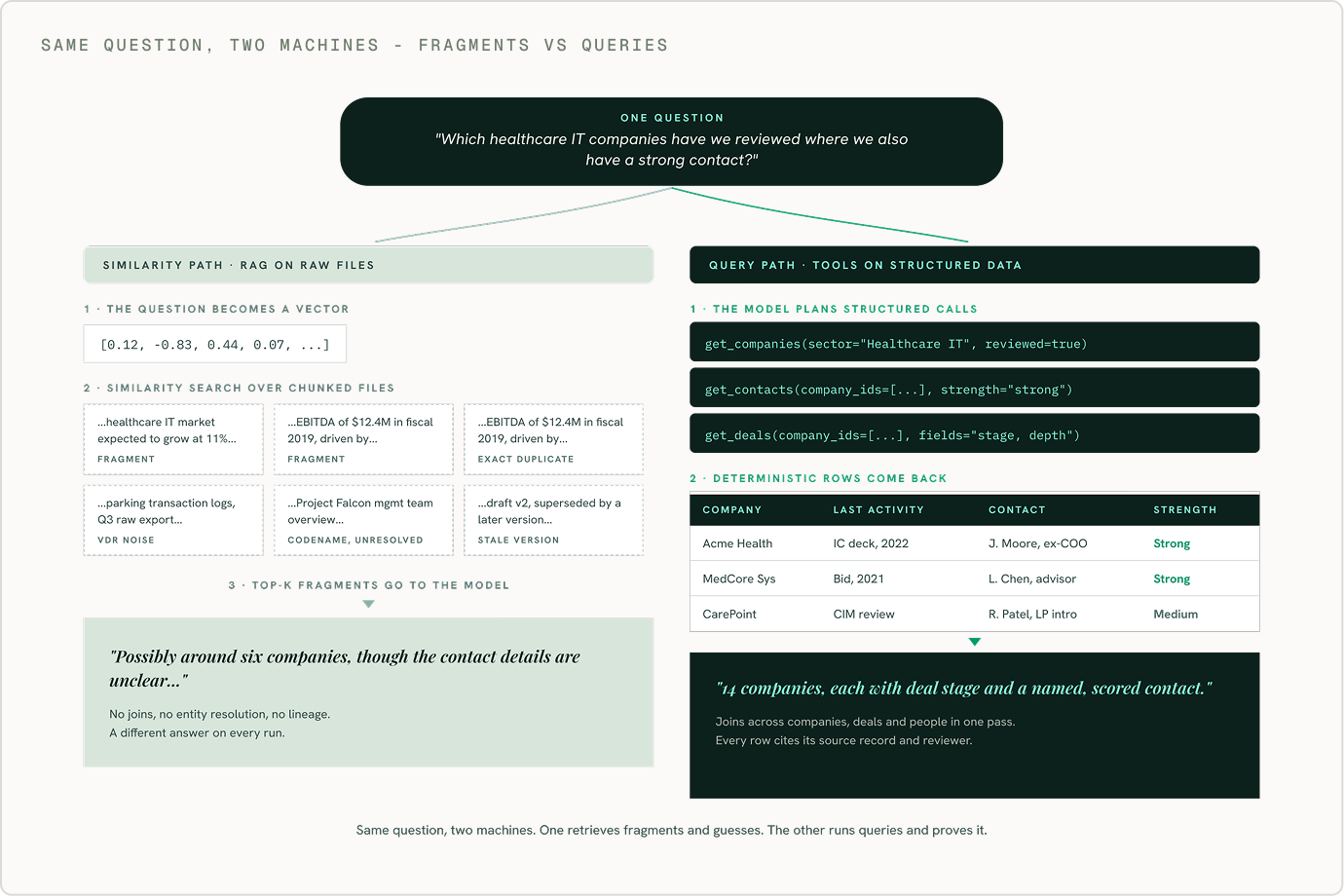
The alternative inverts the model: extract first, then query. AI pulls structured records out of documents upfront, humans confirm and correct them in the Data Studio, and entity resolution collapses scattered mentions into a single canonical record linked to deals, people, and sectors. Exposed through an MCP server, that database lets AI models run deterministic tool calls instead of similarity search — no context window bloat, consistent results across runs, and every fact tracing back to a source document and the reviewer who confirmed it. The pipeline can be adopted in levels, and the starting point is always the same: start with the use case, work backward to the data.
See how we work with funds like yours
The full report has been sent! Check your inbox or spam if you cannot find it.



Get in touch
