Why We Partnered with Omni as Our Go-To AI/BI for Investment Funds


At Soal Labs, we build data infrastructure and AI solutions for private capital firms. Our clients are GPs, Deal teams, IR teams and portfolio operations leaders who run high-stakes workflows on spreadsheets, legacy software, siloed databases, and manual reporting cycles. When we set out to find the right analytics and AI platform to anchor our client work, we evaluated the market thoroughly.
We chose Omni.
This article explains why, what makes Omni different from the alternatives we considered, and how we are using it to build real solutions for private equity and credit GPs.
Soal Labs is an independent Omni implementation partner and receives no commissions, referral fees, or financial compensation from Omni. Our recommendations are based purely on what we have seen work for our clients.
The problem we kept seeing
Every fund we work with runs into the same friction. Portfolio performance data lives in the fund admin system. CRM data tracks LP meetings and pipeline status. Investor profiles sit in spreadsheets. Market intelligence comes from third-party sources.
When a partner asks for a fundraising update or a portfolio review, someone has to export, reconcile, and rebuild the story by hand.
While the more technically mature GPs set out to build centralized data lakes to break the silos, very few have figured out how to consume that data.
Three problems remain:
- First, reporting still takes too long. Recurring reporting still lives in brittle and chaotic Excel workbooks.
- Second, definitions drift between teams. What "committed capital" means for one team may not match what it means in the quarterly report.
- Third, AI tools that sit on top of SQL tables (text-to-sql) notoriously produce answers nobody trusts, because the models lack the business context to get the details right.
We needed a platform that could solve all three at once. A platform that is intuitive, governed and treats AI as a first-class consumption channel.
There is a popular narrative right now that AI will make BI irrelevant. The logic goes that if anyone can ask a question in plain English, the models and tools underneath stop mattering. We think this gets it backwards, and Omni's pace over the past year is the clearest evidence why. In a matter of months they shipped Blobby, their AI agent, an MCP server that lets tools like Claude and ChatGPT query the governed model directly, a Slack agent that brings answers into the channels teams already work in, a Modeling Agent that drafts metric definitions and AI context, Agent Skills that turn repeatable workflows into governed agents on the semantic layer, and AI Hub to observe, validate, and improve all of it, including evals that prove a model change actually improved answers before it ships. What strikes us is not the volume of features but their coherence. Every one of them reads from the same semantic model. That is the opposite of a category being displaced. It is a platform absorbing every new AI surface as another channel into one governed source of truth, and adapting faster than the tools betting that the model no longer matters. AI is not the thing that kills BI. It is the thing that finally makes the semantic layer indispensable, and Omni is building like they understood that first.
What drew us to Omni
The semantic layer is the foundation for AI
The single most important feature in Omni is the semantic layer.
A semantic layer is a governed business model that defines metrics, dimensions, joins, grain, and permissions above raw data. It is usually written in a structured syntax like YAML that is then converted into SQL queries at run time.
In private equity, terms like IRR, MOIC, DPI, RVPI, NAV, committed capital, and re-up score each carry precise definitions that vary by fund and by audience. Omni lets you define each metric once in a shared model, and that definition is enforced everywhere: dashboards, workbooks, spreadsheets, AI answers, and embedded analytics.
While this concept has been considered a nice-to-have to solve the definition drift problem, it has resurfaced in the age of AI.
Most BI tools bolt on an AI chatbot that generates SQL from a prompt. Without a semantic model, those tools are guessing at your metric definitions. Ask "what drove the drop in Fund III performance this quarter?" and a generic AI tool will either hallucinate an answer or return something too vague to act on.
Omni's AI generates semantic queries through the governed model, not raw SQL from text. That means the AI uses the same metric definitions, joins, access controls, and business logic that power your dashboards. The AI agent can plan multi-step analyses, check assumptions, and validate results before summarizing. You can always open the underlying query in a workbook to verify exactly what the AI did.
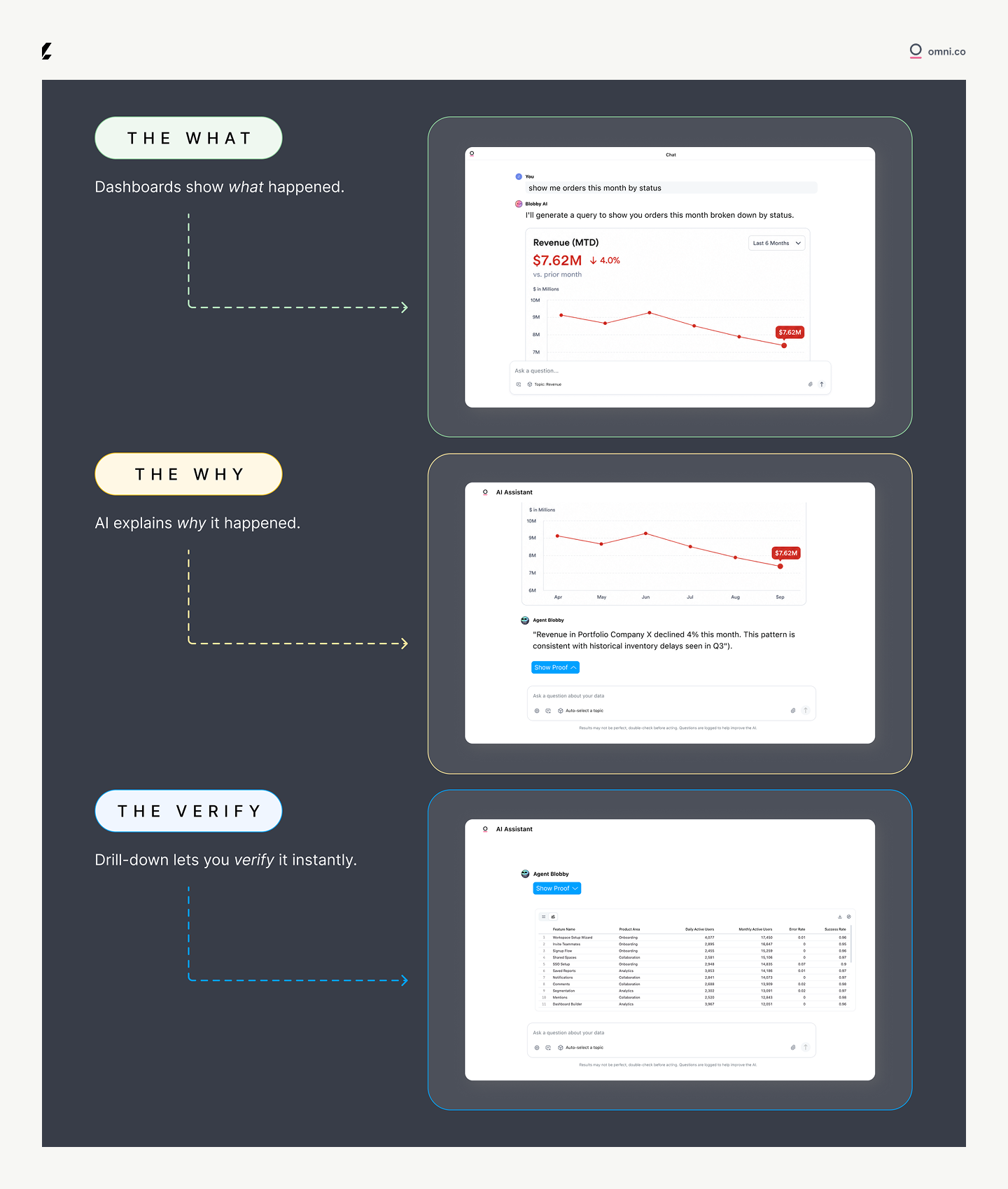
What also sets Omni apart from other semantic layers is the concept of just-in-time modeling. In Omni, it is easy and intuitive for business users (not just engineers) to contribute context directly from the UI. Omni has created intuitive promotion paths for anyone to suggest changes in a governed fashion. When an IR analyst notices that the AI misinterprets "capital raised this quarter," they can update the model's AI context inline, and the fix applies across the organization. Omni calls this a "context flywheel," and in practice it means the platform gets smarter as more people use it.
Spreadsheets on live, governed data
Private equity runs on spreadsheets. Every fund has team members who think in Excel, and asking them to abandon that muscle memory is a losing battle. Omni solved this elegantly: their spreadsheet interface supports the same Excel formulas and shortcuts people already know, but the data underneath is live and governed. Analysts can use familiar Excel-syntax calculations directly on top of warehouse data, and when a formula proves useful, it can be promoted to the shared model so the entire team benefits.
Besides familiarity, this feature brings the “infinite canvas” feel that is a spreadsheet to the analyst. No more exporting CSVs from the BI tool to run a side calculation. No need to involve an engineer to run 5 layers of aggregations. Ad-hoc analysis becomes boundless - yet governed.
The spreadsheet feature also comes in handy for formatting purposes. We come across multiple scenarios where MDs are used to a certain format that is not easily reproduced in traditional BI. Think about forecast modeling, or commission planning. Having Excel parity solves for that.
Omni recently took this a step further by letting you consume the semantic layer directly inside Excel itself. Using a native connection, an analyst can pull an Omni topic into a live pivot table and slice it with all the usual Excel muscle memory, while every request is translated into a governed query against the warehouse in real time. In effect, Omni becomes a headless semantic layer feeding Excel, so an MD can stay in the tool they never left and still be working on live, consistently defined fund data rather than a stale exported snapshot.
Visualizations and exploration that meet the bar
Investment professionals expect clean, information-dense visuals. Board decks, IC memos, and LP updates demand a level of polish that most BI tools struggle to deliver. Omni's visualization layer includes rich chart types, table visualizations with conditional formatting, drill-down capability, and dashboard layouts that hold up in a partner meeting.
More importantly, Omni supports a spectrum of user skill levels in a single platform. A portfolio ops analyst can start with AI chat, then switch to point-and-click exploration, then drop into SQL, then pivot into a spreadsheet view. Those are not separate tools. They are different entry points into the same governed data.
On top of that, Omni has some unique visualization types and exploration paths that are not always considered table stakes. The AI summary visualization for example allows to generate cards that summarize a query’s results with a user-defined prompt. Easy to use funnels and sankeys come out of the box. Another clever feature Omni built is visualization links: it allows for a user to click on a data point in a chart that will dynamically append the URL to take them to another pre-filtered dashboard.
Security and governance for sensitive fund data
Private equity data is sensitive by nature. LP identities, commitment amounts, fund performance, deal pipeline status: none of this should leak between teams and seniorities. Omni enforces granular role-based and row-level security at the semantic layer, which means permissions are applied at query time across every interface, including AI.
For firms embedding analytics into LP portals or client-facing products, Omni's architecture enforces strict tenant isolation so each investor only sees their own data. This is the same approach that Standard Metrics used to launch AI-powered portfolio analytics for VC and PE firms in just 2.5 months using Omni's embedded platform.
Product velocity and customer support
Omni’s product velocity and customer support also stood out. Their Omni demos are a great example: bite-sized, practical walkthroughs that make it easy to see what’s possible and to keep up with new releases. They also run regular Demo Fridays to showcase new features and real customer use cases with the broader community, which creates a strong feedback loop between users and the product team.
Beyond content and events, Omni invests in day-to-day collaboration. They set up shared Slack channels with customers so questions get answered quickly and context stays close to the work. And when teams want to move fast from evaluation to implementation, Omni connects them with vetted service partners who go through extensive training and certification programs—partners like Soal Labs—so clients can get a Quick Start and reach production value quickly.
What we are building with Omni
We are not writing about Omni in the abstract. We are actively building solutions on it for investment fund workflows. We will be sharing anonymized demos that leverage Omni for our audience (think LPs dashboards for AI-powered investor relations and fundraising; porfolio and company-level financial monitoring; etc.)
Why Omni over the alternatives
We evaluated the landscape. Generic BI tools offer visualization but force you to choose between self-service and governance, and their AI features tend to be bolted on without a semantic foundation.
.png)
Omni is the only platform we found that combines a production-grade semantic layer, real AI grounded in business context, spreadsheet-style analysis on live data, rich visualization, embedded analytics, and enterprise security and support in one product. And it connects to every major cloud warehouse (Snowflake, BigQuery, Databricks, Redshift, Postgres) with native dbt integration and Git-based version control.
The recent $120M Series C at a $1.5B valuation, along with customers like Fundrise, Standard Metrics, BambooHR, and Cribl, confirmed what we had already concluded from building on the platform: Omni is where the market is heading.
What this means for investment funds
If you are a GP, IR leader, portfolio operations head, or fund analytics team evaluating your analytics and AI stack, here is what we would tell you:
The barrier to good analytics is no longer access to data. It is trust. Your team already has the data. What they need is a governed layer that connects it, defines it consistently, and makes it accessible to everyone from the Excel-native analyst to the partner asking questions in plain English.
That is what Omni provides. And that is why we chose to build on it.
At Soal Labs, we build data engineering, analytics, and AI solutions for private equity, credit, and fund operations teams. We are an Omni implementation partner. If you want to see what AI-native analytics looks like for your fund, reach out.
Learn more about Omni's AI capabilities, financial services solutions, and data modeling approach.
See how we work with funds like yours


Get in touch
